At least 85% of restaurants are invisible to AI. We measured an entire market to find out why.
We audited every café, restaurant and bar in two markets against ChatGPT, Claude, Gemini and Perplexity. 85.6% were never recommended once — and we found what separates the rest.
By Vladimir Pitenin · Founder & CEO, Norly
Our research is published on arXiv: Invisible to the Machine: Auditing AI Restaurant, Cafe, and Bar Recommendation Against a Complete Market Census. To our knowledge it is the first complete-market audit of AI dining recommendations ever run — not a sample of famous brands, but every café, restaurant and bar in two markets, tested against the four assistants your guests actually use.
4,776
cafés, restaurants and bars — every venue in two Bali markets
2,208
questions asked, the way real customers ask
26,993
sources the AI systems cited — every one logged
1.4M
venue-level opportunities to be recommended
This article is the plain-language version of what we found. It goes finding by finding, with the charts — and if it's useful, the full report goes deeper on every section, free.
Free, no email required · 2026 · Norly Research
How we measured it — and why the numbers hold
Most AI-visibility studies check a handful of well-known brands and report who ranks higher. That can tell you who won; it can never tell you how many lost, because nobody counted the field. We went the other way round, and that one decision is what makes every number in this study possible.
We counted everyone first. Every café, restaurant and bar listed in greater Canggu and greater Ubud — 4,776 venues — each with its public profile: rating, review count, website, price level, opening hours. That register is what makes the word never measurable.
We asked the way real guests ask. Nobody types “best restaurant Canggu.” They ask with a budget, a companion, a dietary need, a laptop that needs Wi-Fi. So we wrote eight guests — the digital nomad, the couple on a date, the business host, the budget backpacker, the family with kids, the vegan, the coffee connoisseur, the late-night group — and gave each six phrasings, in both areas: 96 fixed questions, written and locked before the study began and published word-for-word in the paper, so we could never quietly change the question to fit a result.
We asked repeatedly, across four systems. ChatGPT, Claude, Gemini and Perplexity, each in its live search-connected form — the way their apps actually answer — over seven days, then re-tested two weeks later to check the picture held. It did. That produced 2,208 answers and 12,439 venue mentions, and we traced every single mention back to the register by hand where the automatic match was uncertain.
1,407,600 venue-level opportunities to be recommended. That is the size of the question we put to the data — every venue, against every query, across every repeat.
That 1.4 million figure is the statistical frame: each venue, at each question, on each run, either appeared or it didn't. It is what lets us say a factor raises your odds while holding the others constant — rather than pointing at a few successful venues and guessing what they have in common.
And then we tried to break our own findings. Every headline conclusion was rebuilt three more ways: a second, independent statistical model with different assumptions, which agreed with the main one on all nine factors; a 500-run bootstrap that re-analysed resampled question groups, where the estimates barely moved; and three sensitivity re-analyses — dropping the noisiest AI, keeping only the highest-confidence name matches, changing the outcome definition — none of which changed a conclusion. Our extraction and name-matching were checked against independent human annotation, at 97.6% precision and 99.1% recall. Those error rates are published too.
We're a visibility company writing about visibility, so we'll say the obvious thing: that's exactly why we put it on arXiv instead of in a marketing post. It's open — anyone can read the method, check the numbers, and tell us we're wrong.
Finding 1: most of the market simply doesn't exist to AI
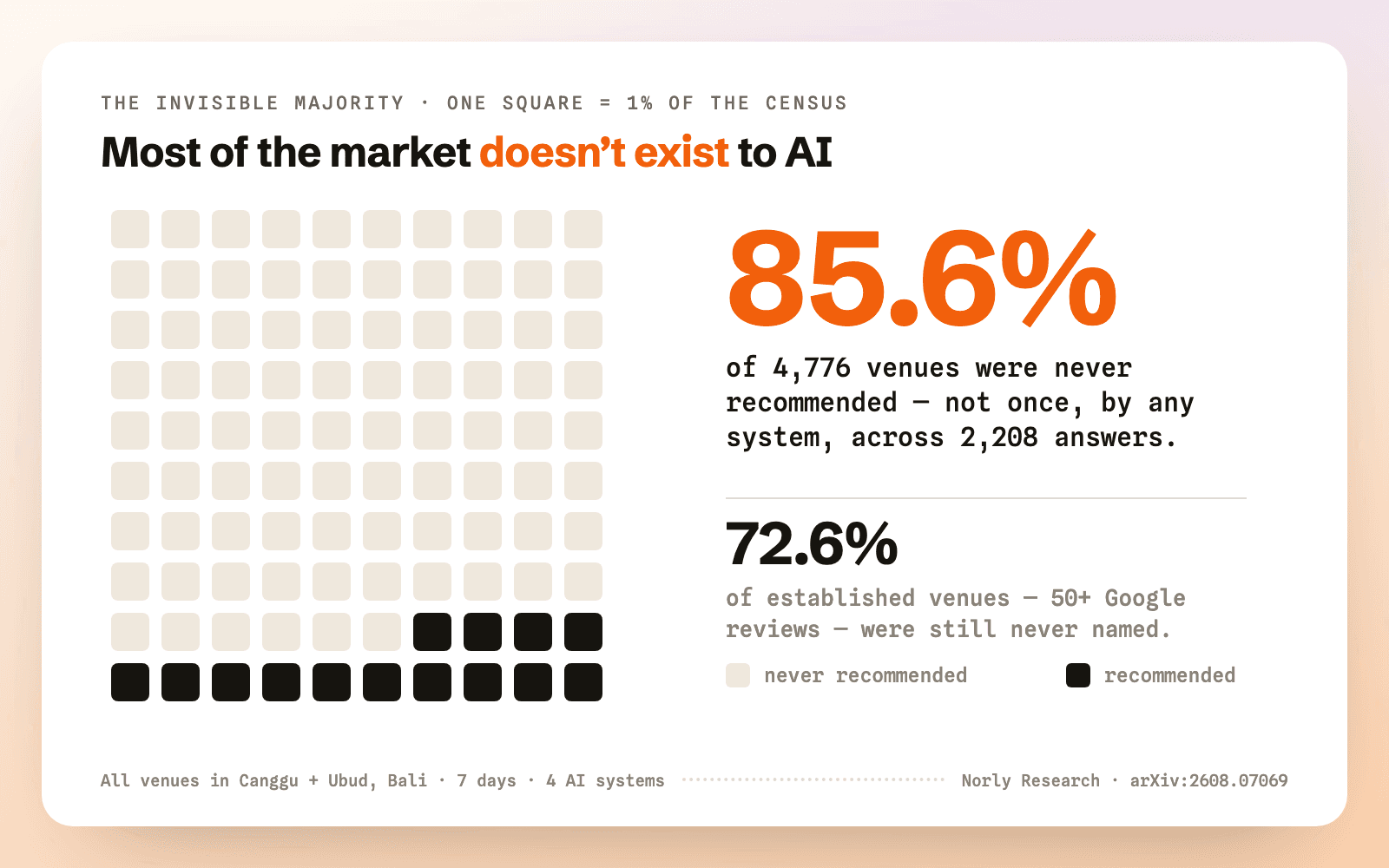
Across 2,208 answers the four systems made 9,791 recommendations — and kept returning to the same small slice of the market. Only 689 of 4,776 venues were ever recommended at all. The other 85.6% were never named once, by any system, in any answer, all week.
The obvious objection is that the invisible ones are marginal — stalls, ghost kitchens, places nobody would recommend anyway. We checked. Among established venues with at least fifty Google reviews — real businesses with real customer bases — 72.6% were still never recommended. Invisibility isn't a quality filter. It swallows most of the legitimate market too.
And 85.6% is the floor, not a headline exaggeration. We attacked our own census: cross-checked it against an independent venue dataset, hand-audited the gap, and used the AIs themselves as an adversarial probe — any venue they could name that we'd missed would have shown up as an unmatched mention. Every counting error we could find pushes the true rate up, not down. Under the broadest defensible definition of the market it exceeds 92%.
Here's the part worth sitting with, though. Among the visible 689 there is no cartel: the single most-recommended venue in the entire study holds just 1.9% of all recommendations, and the top five together hold under 8%. Nobody owns these answers. There is no incumbent to displace — the wall is at the door, and doors open.
Finding 2: AI picks in two stages — and nobody had measured this before
This is the study's central discovery, and the one we haven't seen measured anywhere else. AI recommendation isn't one contest. It's two, and the factors that win the first have almost nothing in common with the factors that win the second.
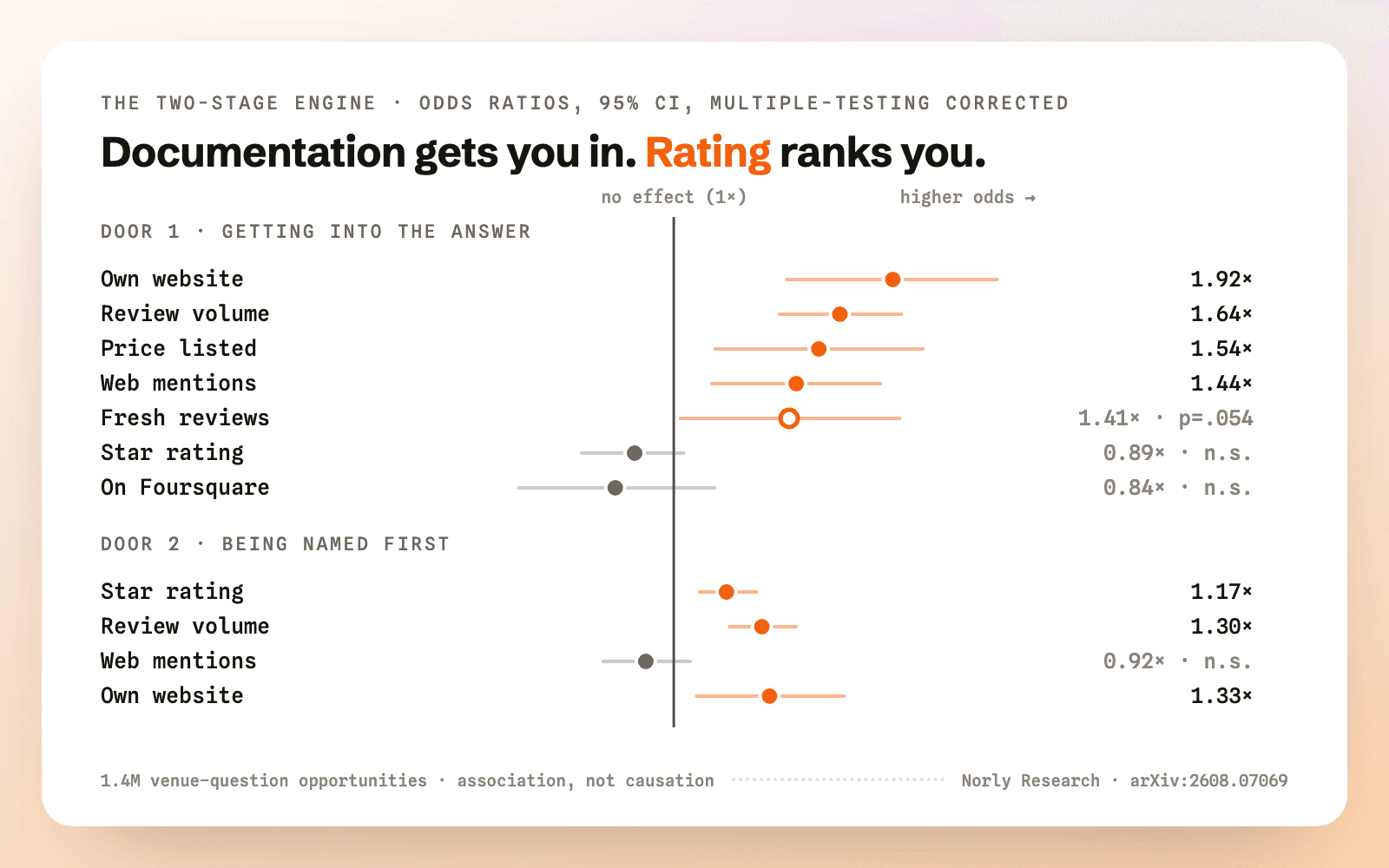
Door one — getting into the answer at all. Before anything else, the system has to find you in the material it reads. Everything that matters here is documentation: having your own website (1.9× the odds), review volume (1.6× per step), a filled-in price level (1.5×), mentions across the web (1.4× per step). Your star rating does nothing at this door — statistically indistinguishable from no effect. A 4.9-star venue with a thin footprint loses to a 4.3 with a thick one.
Door two — being named first. Once you're inside the answer the logic flips. Now your rating is a real signal (1.17× per step), review volume still helps (1.3×), your website still counts (1.33×) — and raw web presence stops mattering. The system composes a shortlist from what it retrieved, then orders it by merit.
Your rating decides where you rank. Your paper trail decides whether you exist at all.
This reframes the industry's default advice. Pushing a rating from 4.5 to 4.7 is a door-two move — and most venues never reach door two. If AI isn't naming you, the first suspect isn't your food or your service. It's your documentation. Which is good news, because unlike your rating, that's entirely within your control.
Finding 3: reviews count at both doors
Read the two lists together and something useful emerges. Most factors work at one door or the other: web mentions and a listed price level get you in but stop mattering for rank; your star rating does nothing until you're already inside. Two things carry across both doors — your website, and your reviews.
- Volume opens the door. Each step up in review count multiplies your odds of entering an answer by 1.6×. At this stage the systems are reading how much is written about you, not how highly you're rated.
- Rating ranks you inside it. Once retrieved, each step up in stars multiplies your odds of being named first by 1.17× — and volume keeps helping here too (1.3×).
- Freshness very likely holds it open. Recent reviews came in at 1.4× — more on that below.
So the arithmetic that actually matters isn't 4.6 versus 4.9. It's 4.6 with 900 reviews against 4.9 with 40 — and the first venue wins twice over: it gets into answers the second one never enters, and it holds its own on rank once there. Your website is the other factor that spans both doors, and it's the stronger one for getting in — but you build a website once. Reviews are the part that has to keep happening, and they're the only lever here that a room full of happy guests can move for you every single day.
Finding 4: freshness — the one we very nearly proved
The share of recent reviews came in at 1.41× per step — a solid effect, pointing the right way, and it cleared the conventional statistical threshold. It then missed our threshold, because we corrected for testing nine factors at once and the p-value landed at .054 against a .05 bar.
We're reporting that exactly as it is: very likely, not proven. But we'd be doing you a disservice to bury it, because the direction and the size both make sense with everything else we measured — and because the next finding shows precisely what happens when a venue's record goes stale.
Finding 5: AI doesn't invent restaurants — it remembers dead ones
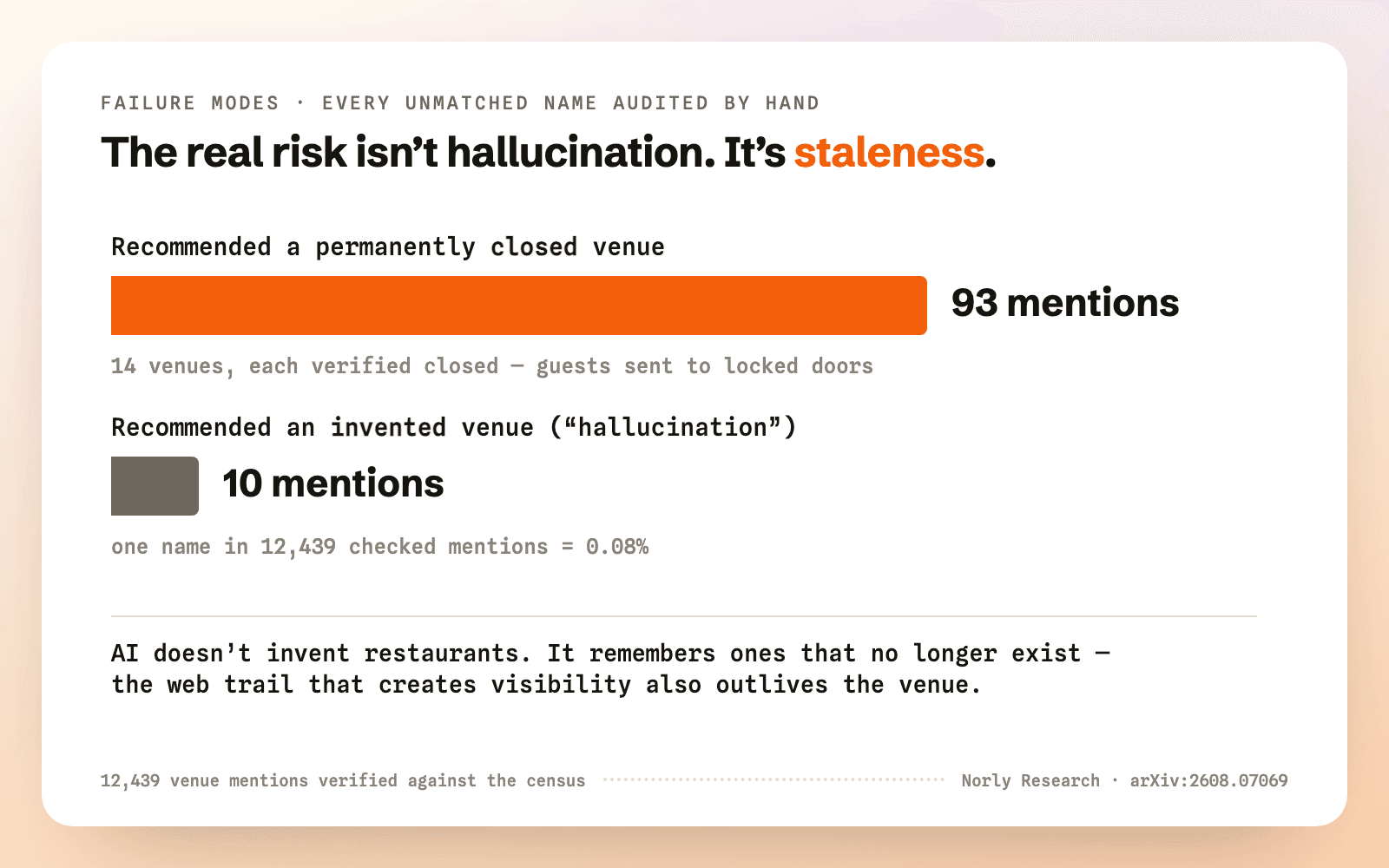
Ask anyone what's wrong with AI recommendations and you'll hear one word: hallucinations. We went looking. Out of 12,439 venue mentions, exactly one name — ten mentions, 0.08% — survived scrutiny as likely invented. The famous problem is, in this market, almost nonexistent.
What we found instead: the systems recommended permanently closed venues 93 times, across 14 confirmed-dead establishments. A guest following that answer arrives at a locked door. And the mechanism is the same one that creates visibility in the first place — a closed café's reviews, blog mentions and listicle entries don't disappear when the doors shut. The paper trail outlives the business.
Which is the practical case for freshness, from the other direction. The record AI reads about you has to be current, and the freshest signal any venue controls is a steady stream of new reviews.
Finding 6: what AI actually reads — 26,993 sources, logged
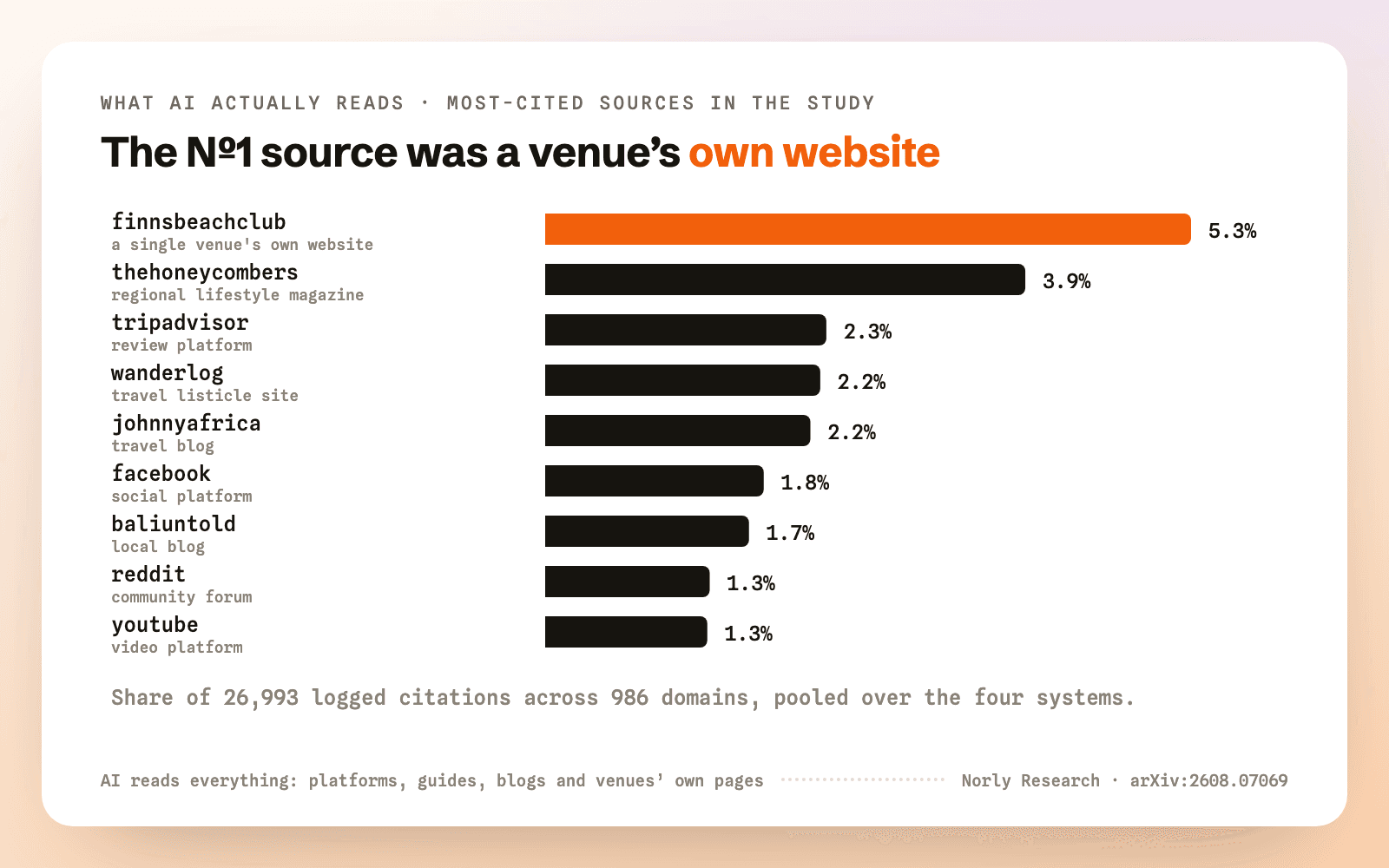
Every time a system answered, we logged what it cited — 26,993 citations across 986 different sources. This is the closest thing anyone has to a reading list for AI dining recommendations, and it's more varied than most owners expect.
The big review platforms are right there among the most-quoted sources — TripAdvisor sits third overall, and Facebook, Reddit and YouTube all appear in the top ten. Around them: regional lifestyle magazines, travel blogs, listicle sites, local guides. And in first place, one venue's own website — cited more than any single platform in the whole study.
The practical reading isn't that one source beats another. It's that AI reads everything around your venue, and each of those things is a document it can retrieve. Every platform profile you keep alive, every review a guest writes, every guide that mentions you adds another. Venues present across many sources turn up in many answers; venues thin on the record turn up in none — which is exactly where the 85.6% comes from.
Finding 7: there is no single “AI ranking”
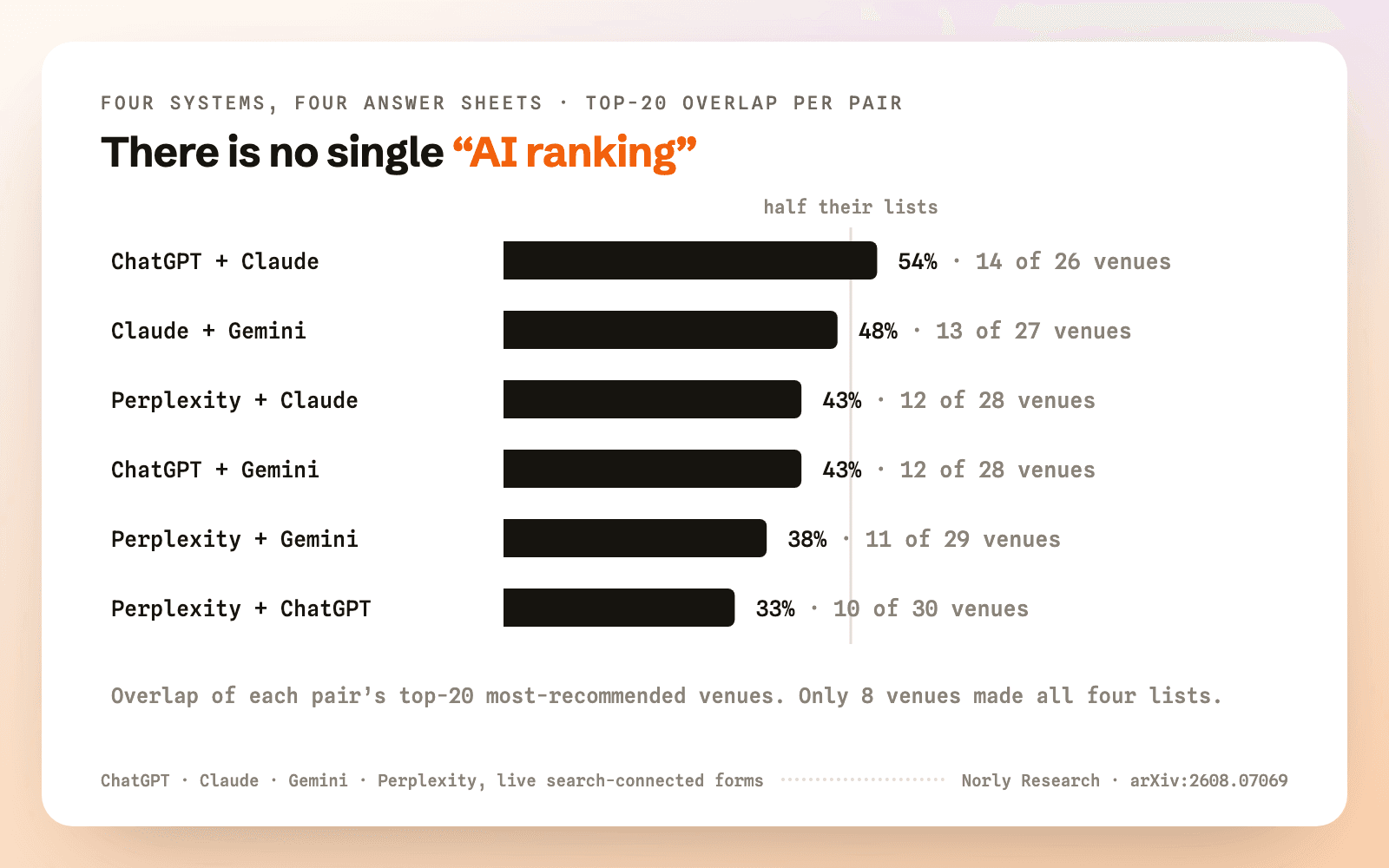
If AI recommendations were one league table, the four systems would name roughly the same venues. They don't. Any two agree on only 33–54% of their top-20, and of the 37 venues appearing in anyone's top-20, just 8 made all four lists. Being ChatGPT-famous does not make you Gemini-famous.
It goes further: the same system answers differently between askings. Identical repeated questions returned venue lists overlapping only 22–45%. But when we re-ran the study two weeks later, the overall picture was as stable as it was day to day — so this is noise around a stable signal, not drift.
Which has a blunt practical consequence. If you ask ChatGPT about your venue once and celebrate — or panic — you've measured a coin flip. Real visibility measurement needs repetition, several phrasings and several systems. Anyone selling you a “your AI rank” screenshot from a single query is selling you noise.
What we expected, and what the data refused to confirm
We didn't go in neutral. We had hypotheses of our own — including a well-liked theory in this field that presence in structured point-of-interest databases quietly feeds AI visibility. We built part of the study specifically to test it. Once ordinary documentation was accounted for, it showed no effect at either door. In earlier, messier data it had looked strongly positive; better name-matching erased it, which taught us a second lesson worth passing on — sloppy matching manufactures findings, including in studies we nearly published ourselves.
One more variable behaved strangely enough that we traced it back to our own data collection rather than reality, and excluded it. Both episodes are reported in full in the paper. We'd rather publish the hypotheses that failed than quietly drop them — it's the part that tells you which of the surviving numbers you can lean on.
What the visible venues have in common
Ranked by the strength of the association in our models — the measured anatomy of visibility, not a guaranteed recipe:
- 01They have their own website. The strongest single entry factor (1.9×), and the citation logs show why: the systems read venue sites directly and quote them. It doesn't need to be elaborate — it needs to exist and answer what a guest asks.
- 02They accumulate reviews continuously. Volume at the door (1.6× per step), rating at the ranking (1.17×), freshness very likely holding it open. The one habit that compounds at both stages.
- 03Their profiles are complete. A filled-in price level alone: 1.5×. Hours, menu, photos, attributes — mundane, controllable, measured.
- 04They exist beyond any one platform. Mentions across guides, blogs and local media: 1.4× per step — and those are the sources AI's citations actually point at.
- 05They keep the rating in perspective. It matters, but only after retrieval. 4.6 with 900 reviews beats 4.9 with 40, twice over.
Read it, check it, argue with it
Everything above is a summary. The full report walks through each finding with its chart and the reasoning behind it, in the same plain language as this article.
Free, no email required · 2026 · Norly Research
For the complete method, all 96 queries verbatim, ten figures and the replication package, the paper is on arXiv — also available as PDF or HTML.
Cite it as: Pitenin, V. (2026). Invisible to the Machine: Auditing AI Restaurant, Cafe, and Bar Recommendation Against a Complete Market Census. arXiv:2608.07069. Share and quote it freely, with a link.
This study covered one region and one language on purpose — a bounded market we could census completely. Replication in a structurally different market is next, along with the intervention study that would turn these measured associations into cause and effect. We'll publish that one the same way.
Sources

Vladimir Pitenin
Founder & CEO, Norly
Building visibility tools for cafés and restaurants. Writes about reviews, maps and AI search — with sources.
Read next
How to make your restaurant visible to AI: a practical guide
Guests now ask ChatGPT and Google's AI where to eat. Six practical moves — data consistency, detailed reviews, earned media and more — that decide whether the answer includes you.
What the research actually says about AI visibility: 5 studies, explained
GEO advice is everywhere; evidence is rarer. We read the peer-reviewed papers and consulting studies on AI search so you don't have to — here's what holds up, explained for restaurant owners.