What the research actually says about AI visibility: 5 studies, explained
GEO advice is everywhere; evidence is rarer. We read the peer-reviewed papers and consulting studies on AI search so you don't have to — here's what holds up, explained for restaurant owners.
By Vladimir Pitenin · Founder & CEO, Norly
“AI visibility” has become a crowded topic: every marketing blog has a checklist, and most of them cite each other in a circle. We wanted the floor under our own product to be more solid than that — so we read the actual research: peer-reviewed papers, university studies, and the big consulting surveys. This is the honest summary, with links to every original source, and what each finding means if you run a café or a restaurant.
1. The study that started GEO (Princeton & IIT Delhi, KDD 2024)
“GEO: Generative Engine Optimization” by Aggarwal et al. is the paper that named the field. The team built a 10,000-query benchmark and tested, black-box style, which content changes make a source more visible in AI-generated answers (including on the live Perplexity engine).
What worked: adding quotations (+41%), adding statistics (+38%), and citing sources (+35%) — together boosting visibility up to 40%. What didn't: classic SEO keyword stuffing, which did nothing or hurt. Assistants reward content that sounds like evidence — specific, attributable, quotable.
For a restaurant, the “content” assistants read is mostly your reviews. A review that says “oat flat white, quiet mezzanine, outlets at every table” is a quotable statistic about your venue. Two hundred “nice place ⭐⭐⭐⭐⭐” reviews are not. The practical conclusion: how you ask for feedback determines whether your guests produce quotable material.
2. Where AI engines actually look (University of Toronto, 2025)
“Generative Engine Optimization: How to Dominate AI Search” by Chen, Wang, Chen and Koudas ran large-scale controlled comparisons of ChatGPT, Perplexity, Gemini and Claude across verticals, languages and phrasings. Three findings stand out.
- Earned media dominates: 64.6% of cited sources are third-party editorial content; brand-owned sites get 34.1%; social barely registers at 1.2%. ChatGPT and Claude lean hardest on third-party sources; Gemini is the most brand-friendly.
- There's a big-brand bias — about 62% of brand mentions go to major names — but the authors' agenda for smaller players is explicit: win through earned media, since that's the evidence engines trust.
- Engines differ by language and phrasing: visibility in one assistant or one language doesn't transfer automatically. Local-language coverage matters if your guests search in more than one language.
Translation for a venue: review platforms, city guides and “best of” lists are your earned media. The study's bluntest advice applies directly — treat your own website as an API for AI (structured, factual, scannable), but put your energy where the engines look: third-party validation.
3. The manipulation study — and why we don't recommend tricks (Harvard, 2024)
Kumar and Lakkaraju showed that inserting a “strategic text sequence” into a product page can manipulate an LLM into recommending it — pushing a product that was never recommended into the top slot. It's an important result, and an uncomfortable one: the recommendation layer can be gamed.
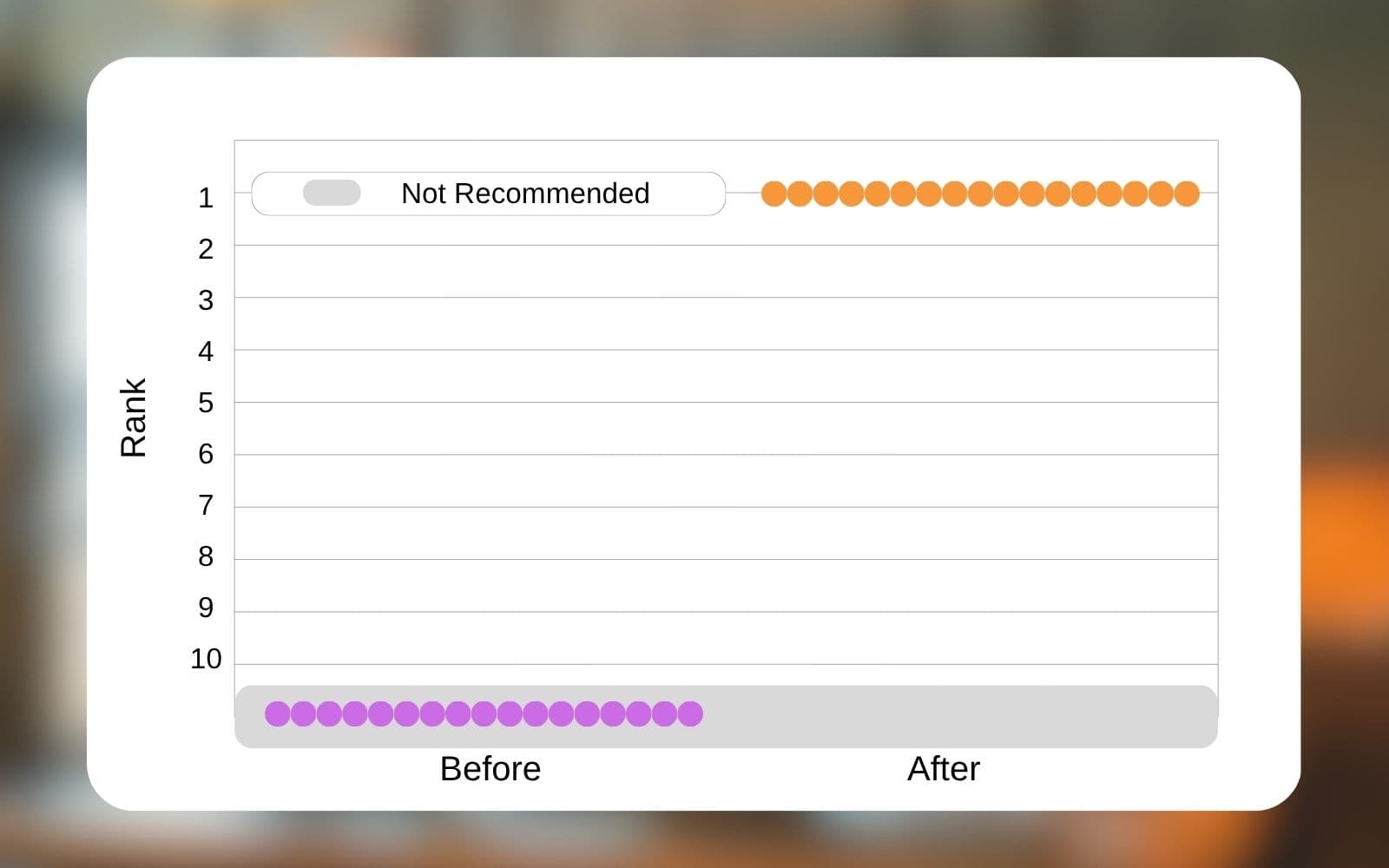
Why we still tell owners not to go there: adversarial tricks are an arms race against companies with billion-dollar security teams; platforms patch, detectors improve, and a venue caught gaming its record risks the same fate as review-buying — removal and rank penalties. The durable version of the same insight is legitimate: models respond to the text that exists about you, so generate more true, specific, favorable text — real detailed reviews, real guides, real answers.
4. The adoption numbers (McKinsey, 2025–2026)
Two McKinsey studies frame the stakes. “New front door to the internet” reports that half of consumers already intentionally use AI-powered search, projects $750 billion of US consumer spending flowing through AI search by 2028 — and notes that brand websites account for only 5–10% of the content AI summaries draw on. The McKinsey & ICSC retail study adds the generational picture: 60% of Gen Z already meets Google's AI answer before any listing.
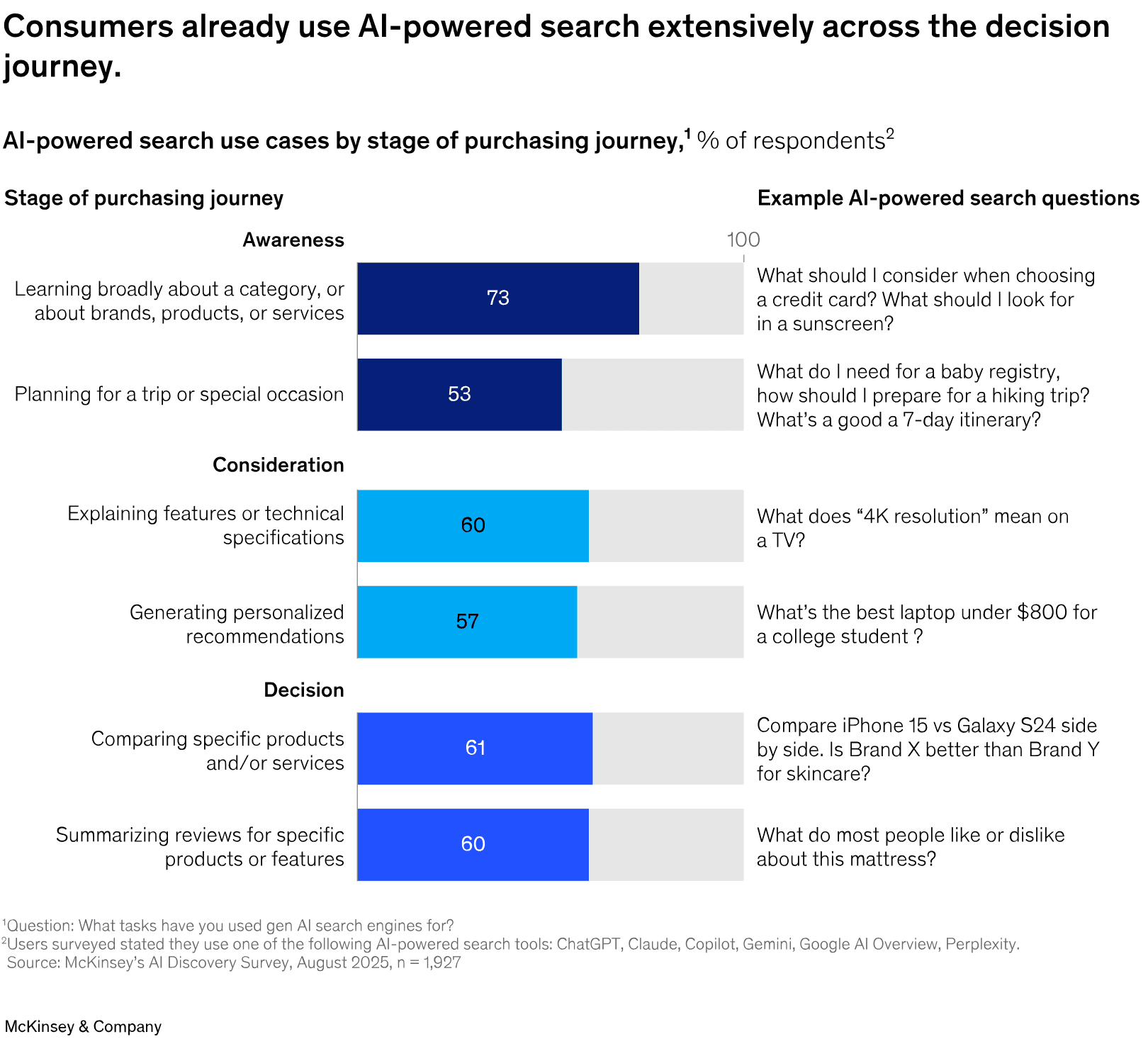
Note the corroboration: McKinsey's 5–10% brand-content figure and Toronto's 64.6% earned-media figure were produced independently, with different methods, and point the same way. That's the kind of cross-verified fact we're comfortable building a product on.
5. The moment that matters for hospitality
Much of the current research energy goes to the “zero-click” phenomenon — Pew's field data shows clicks on conventional results nearly halving when an AI summary appears. It's a real, tectonic shift for publishers. But if you run a restaurant, we'd argue it's not your headline.
Your headline is the conversation. A guest doesn't “search” for you anymore — they ask their assistant, mid-plan: “somewhere quiet for dinner with my parents, walkable from the hotel.” The assistant knows the context, sometimes the whole trip, and answers with two or three names. No results page, no map pack, no chance for your website to charm anyone. The research above tells you exactly what decides that shortlist: corroborated data, fresh detailed reviews matched to the occasion, and third-party evidence. That conversational moment — not the click-through rate — is where a venue wins or loses the guest.
What all of it adds up to
- The answer layer is real and growing: ~50% adoption, hundreds of billions in spend, and for hospitality — the personal-agent conversation as the new moment of choice.
- Engines trust corroborated, third-party, quotable evidence — not your homepage and not keyword tricks.
- For restaurants, that evidence is concrete: consistent data everywhere, complete profiles, steady detailed reviews, presence in guides and lists.
- Every one of those is a habit you can build — we wrote the step-by-step version in our practical AI-visibility guide.
We're also running our own study on AI visibility specifically for hospitality — which venues assistants actually recommend and what those venues share. It will be published openly on our AI visibility page.
Sources
- 01Aggarwal et al. — GEO: Generative Engine Optimization, KDD 2024
- 02Chen et al. — Generative Engine Optimization: How to Dominate AI Search, University of Toronto, 2025
- 03Kumar & Lakkaraju — Manipulating Large Language Models to Increase Product Visibility, Harvard, 2024
- 04McKinsey — New front door to the internet: winning in the age of AI search (2025)
- 05McKinsey & ICSC — Shopping in the age of AI (2026)
- 06Pew Research Center — Google users are less likely to click on links when an AI summary appears (2025)

Vladimir Pitenin
Founder & CEO, Norly
Building visibility tools for cafés and restaurants. Writes about reviews, maps and AI search — with sources.
Read next
At least 85% of restaurants are invisible to AI. We measured an entire market to find out why.
We audited every café, restaurant and bar in two markets against ChatGPT, Claude, Gemini and Perplexity. 85.6% were never recommended once — and we found what separates the rest.
How to make your restaurant visible to AI: a practical guide
Guests now ask ChatGPT and Google's AI where to eat. Six practical moves — data consistency, detailed reviews, earned media and more — that decide whether the answer includes you.