AI visibility · Norly Research
&AI searchHow AI decides where people eat. Measured.
Ask ChatGPT for “a good breakfast spot nearby” and it names three places with confidence. That answer isn't advertising, and it isn't random. We measured an entire market to find out exactly how it gets made — and published the study on arXiv, where anyone can read it and any researcher can challenge it.
The search box got an opinion
For twenty years, being findable meant ranking in a list. Now assistants answer with a recommendation — a shortlist of a few names, typically three to eight, not ten blue links. Either you're in the answer, or you don't exist for that guest. We wanted to know exactly what separates the two — so we measured an entire market.
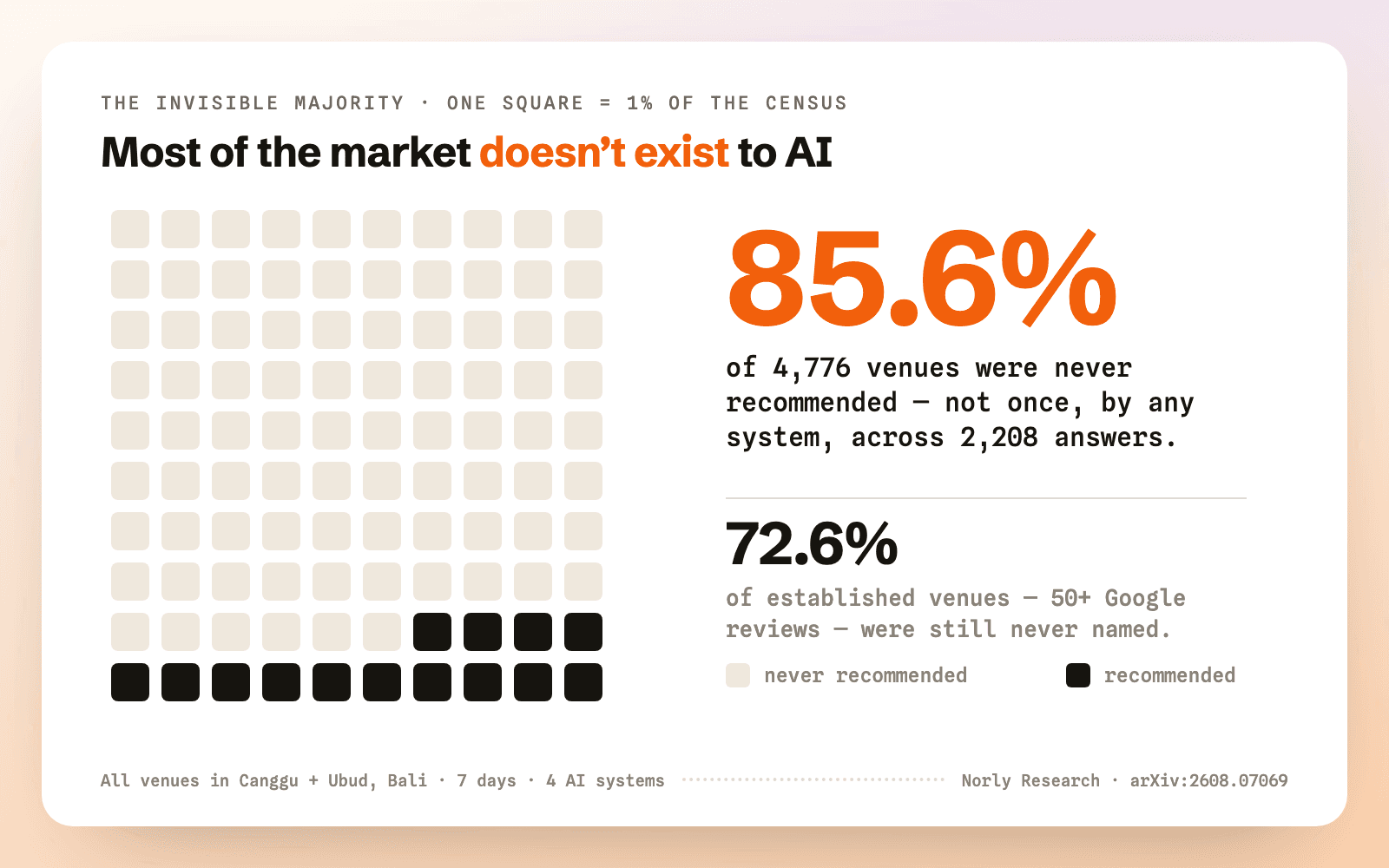
Most venues don't exist to AI
Invisibility is not a quality filter — it swallows most of the legitimate market too. But look at the third number: among the visible few there is no cartel. Nobody owns the answers. The wall is at the door, and doors open.
85.6%
of 4,776 venues were never recommended — not once, by any system, across 2,208 answers.
The central finding
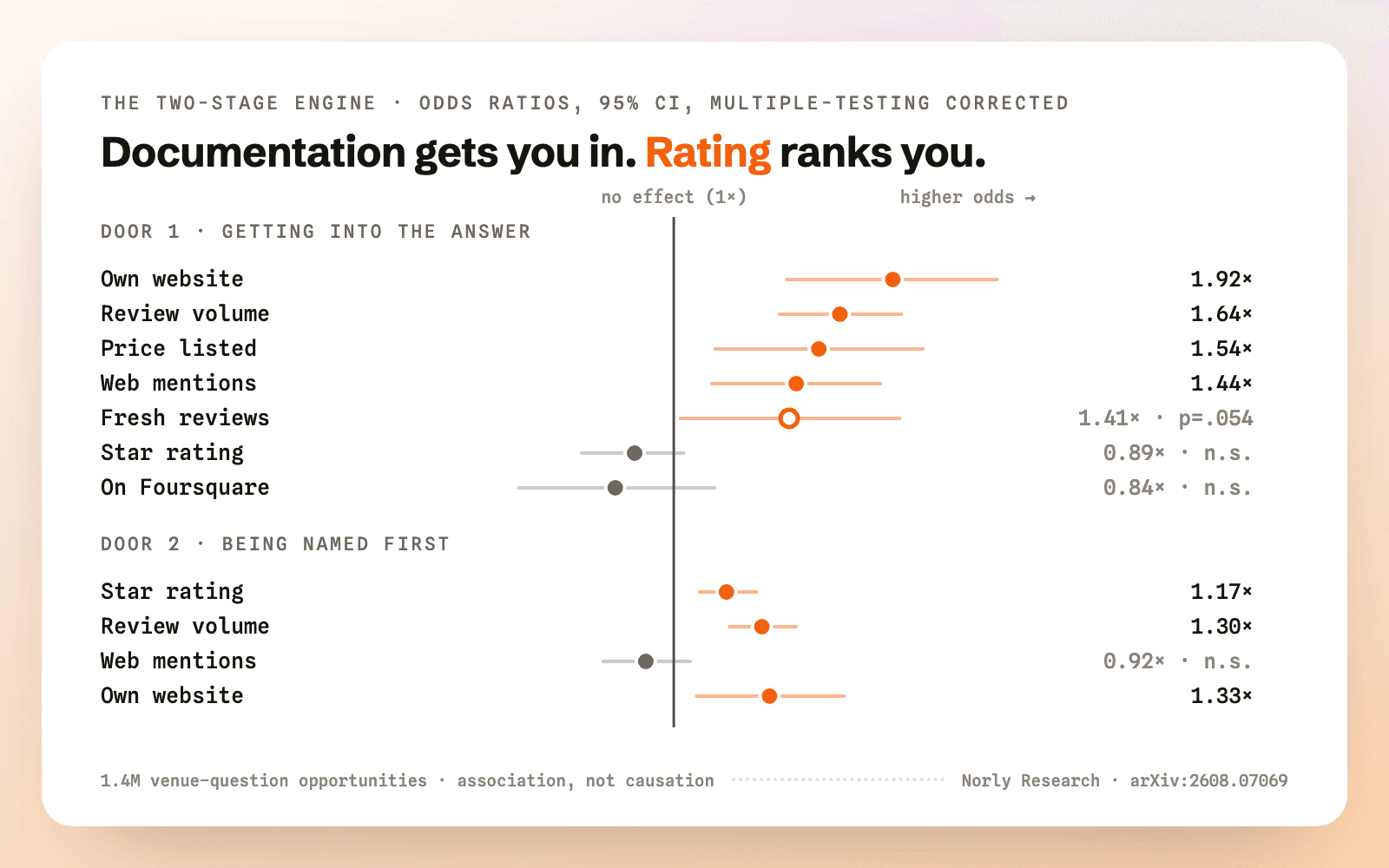
AI picks places in two stages — and review signals work at both
The factors that get a venue into an answer are almost entirely different from the factors that rank it once inside. Most advice about “AI visibility” fails because it doesn't know which door it's talking about. The study measured both:
Door 1 · Getting into the answer
The systems have to find you in what they read. This door runs on your paper trail:
A 4.9-star venue with a thin footprint loses this door to a 4.3 with a thick one.
Door 2 · Being named first
Once you're inside the answer, the logic flips — now quality signals order the shortlist:
Raw web presence stops mattering here. The model ranks what it retrieved by merit.
Most factors work at one door or the other. Two carry across both — your website and your reviews. Volume gets you into answers (1.6× per step), rating ranks you once you're in (1.17×), and fresh reviews very likely help at the entry door too (1.4× — just shy of the study's deliberately strict statistical bar, so we say “very likely,” not “proven”). You build a website once; reviews are the part that has to keep happening, and the one your guests can move for you every day.
What AI actually reads
We logged every source the systems cited — 26,993 citations across 986 domains. AI reads everything around your venue: the big review platforms are among the most-cited sources, alongside travel guides, listicles, local blogs, forums — and venues' own pages. Every platform profile you keep alive, every review a guest writes, every mention in a guide is a document AI can retrieve. Venues present across many sources appear in many answers; venues thin on the record don't appear at all.
And that record has to stay fresh. The systems recommended permanently closed venues 93 times — old reviews and listicles kept dead venues “alive” in the answers. (Invented venues? One name in 12,439 mentions. Staleness, not hallucination, is the real failure mode.) The freshest signal a venue controls is a steady stream of new reviews.
Why you can trust these numbers
This is what separates a measurement from a marketing claim: we counted everyone first, we locked and published our hypotheses and analysis plan before collecting the data (pre-registration), we asked the way real guests ask, and we verified every name the systems produced.
4,776
venues censused — every café, restaurant and bar in two markets
96
fixed questions: 8 guest personas × 6 phrasings × 2 areas
2,208
answers from ChatGPT, Claude, Gemini and Perplexity over 7 days
12,439
venue mentions, each verified against the census
1.4M
venue-question opportunities in the statistical model
26,993
citations logged — every source the systems read
One more thing the measurement exposed: there is no single “AI ranking.” Any two systems agree on only 33–54% of their top-20, and even the same system answers differently between askings. A one-off “does AI recommend me?” check measures luck. Real visibility measurement needs repetition, multiple phrasings and multiple systems — which is exactly how our venue checkup below works.
What actually moves AI visibility
The measured profile of the venues AI recommends — in the order that matters for a working venue:
- 01Build your own website. The strongest single factor in the study: 1.9× the odds of getting into an AI answer — and in our citation logs, a venue's own site was the most-quoted source of all. The systems read it and quote it directly. It doesn't need to be elaborate; it needs to answer plainly what a guest asks: where you are, when you're open, what you serve, what you're known for. Talk to us before you build — we'll tell you what yours should say for visibility, whether you can do it yourself, and who to hire if not.
- 02Accumulate reviews, continuously. The one habit rewarded at both doors: volume opens answers (1.6× per step), rating ranks you inside them (1.17×), and freshness very likely keeps you current. A steady stream beats any burst campaign — and it's exactly the habit a table QR builds.
- 03Be present everywhere AI reads. The systems cite review platforms, guides, blogs and forums in the same breath — venues alive across many sources appear in many answers. One code covering every platform at once is the shortcut.
- 04Complete every profile field. A filled-in price level alone: 1.5× the odds. Hours, menu, photos, attributes — mundane, controllable, measured.
- 05Stop obsessing over the rating decimal. Stars only start working after you're in the answer — 4.6 with 900 reviews beats 4.9 with 40, twice over.
*Fresh reviews: 1.41×, just shy of the study's strict significance bar (p = .054) — reported as very likely, not proven. All effects are measured associations under controls.
Free · takes us a few days · no strings
How visible is your venue to AI?
Leave your venue and email — we'll ask the assistants about your neighborhood, check your data across platforms, and send you an honest checkup: where you show up, where you don't, and what to fix first.
Where Norly fits
Every lever above is a habit — and habits need a system. Norly turns them into one: the QR on the table produces steady, recent reviews; the video ask produces detailed ones; one code covers every platform at once; and the analytics show it's actually happening.
Signal → system
Norly Research
Research hub →The study is published — read it, take it apart
Norly builds visibility software for hospitality, which is exactly why we didn't answer this question with a marketing post. We published the study on arXiv, in the open: anyone can read it, and any researcher can challenge it — including the two results that went against our own expectations, which are reported in full.
Also: HTML version · the plain-language read on our blog
Pitenin, V. (2026). Invisible to the Machine: Auditing AI Restaurant, Cafe, and Bar Recommendation Against a Complete Market Census. arXiv:2608.07069. DOI: https://doi.org/10.48550/arXiv.2608.07069
One region, one language, deliberately — a bounded market we could census completely. Next: replication in a structurally different market, and the intervention study that turns measured associations into a recipe.
Norly Research · 2026
Canggu + Ubud, Bali · censused in full
invisible to the machine